The origins of cashmere
What is cashmere? Origins, history & production
Before it becomes a colourful garment with a modern, distinctive cut, cashmere begins its journey thousands of miles away, on the high plateaus of Central Asia. Rare, precious and demanding to work with, it is a fibre whose every facet we are delighted to share with you.
What is cashmere? Where does it come from?
Cashmere is a natural animal fibre made from the down of the cashmere goat, Capra hircus. These goats live mainly on the high Himalayan plateaus and in Inner Mongolia, where winters can be exceptionally harsh and temperatures can fall to -40°C.
To withstand this intense cold, the goat naturally grows a very fine, soft and exceptionally insulating undercoat beneath its coarser outer coat. This down, and only this down, becomes cashmere. Today, China accounts for most of the world’s production, while some of the fibre has historically been processed in Europe, notably in Italy and Scotland.
Why is it called "cashmere"?
The name does not necessarily indicate exactly where the fibre comes from. It derives from the Kashmir region, now divided between India, Pakistan and China, where the weaving of this precious fibre developed and the resulting textiles were exported to the West, even when the raw material came from elsewhere.
How is cashmere fibre harvested?
Every spring, cashmere goats naturally shed their winter down. This is when herders harvest the precious fibre, usually by hand, using a special comb to gently remove the undercoat without harming the animal or damaging its outer coat. Some herders also shear their goats, a quicker method that then requires more careful sorting to separate the fine fibres from coarser hair.
The yield is modest: each goat produces an average of 150 to 200 grams of usable down per year. It takes the fleece of several goats to make a single jumper, which goes a long way towards explaining the rarity and value of cashmere.
How is cashmere made?
Once harvested, the raw fibre goes through a lengthy process before becoming a garment.
Sorting and washing
The fibres are first sorted to separate the fine down used for luxury cashmere from the coarser hair destined for other uses. They are then washed to remove impurities and natural residues.
Combing
Next comes combing, which untangles the fibres and aligns them in the same direction. This essential step shapes the softness and consistency of the finished yarn.
Spinning
The combed fibres are spun into a continuous, strong yarn. Its thickness varies according to its intended use: the more strands used, the thicker and warmer the finished knit.
Knitting
Finally, the cashmere yarn is knitted into a finished garment: a jumper, poncho, cardigan or scarf…
This is how Absolut Cashmere pieces come to life: thoughtfully made garments with the modern, distinctive cuts that define our collections.
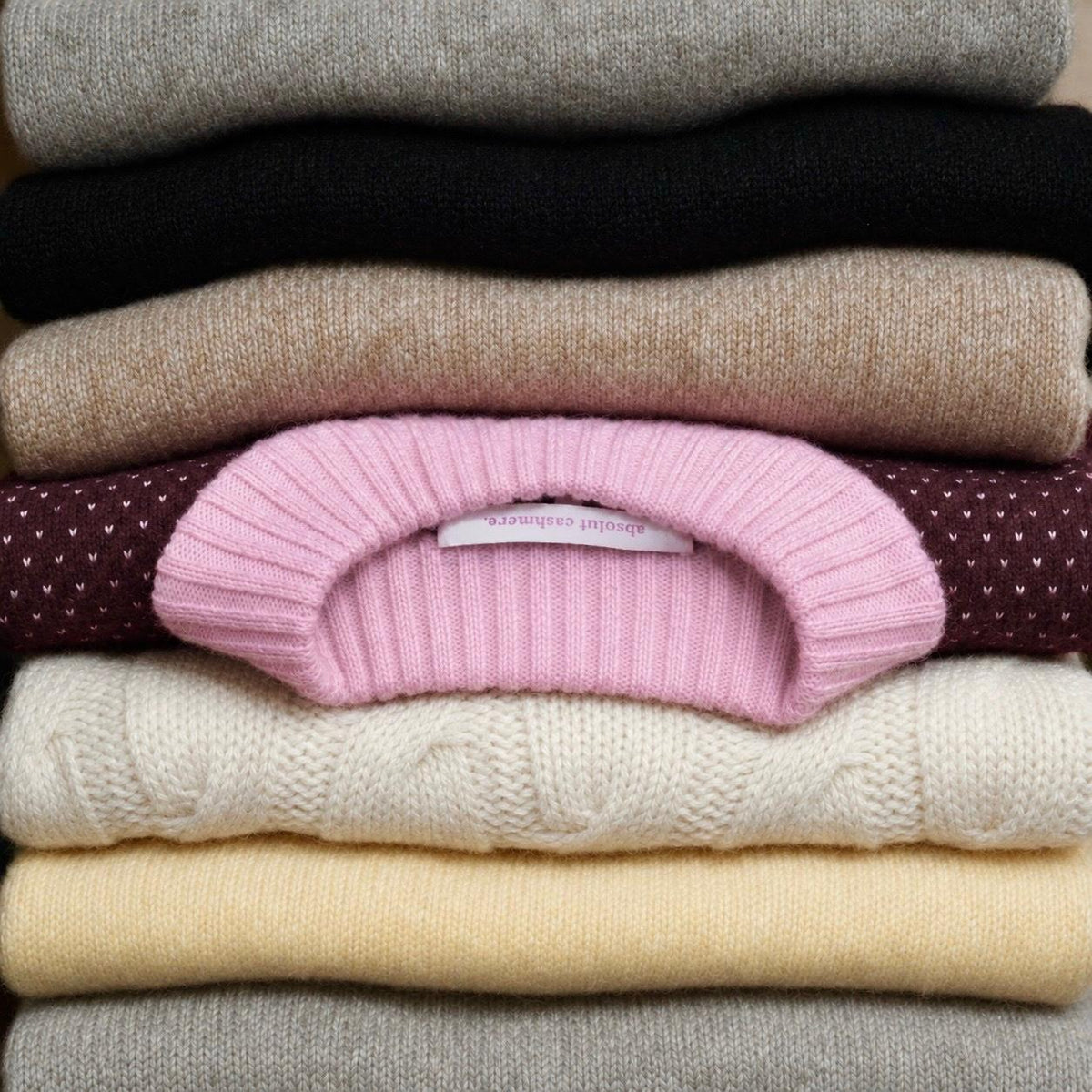
Why is cashmere so precious?
Several factors combine to explain the price of cashmere:
- The rarity of the raw material: each goat produces only a tiny amount of down each year, far less than the wool yielded by a sheep.
- The number of goats required: it takes the fleece of several goats to make a single garment.
- Harvesting by hand: hand-combing takes time and expertise passed down through generations.
- The meticulous production process: sorting, washing, industrial combing, spinning and knitting all demand precision and expertise.
There is a welcome upside to these exacting standards: with proper care, a quality cashmere garment stays soft for years to come.
A story spanning centuries
Cashmere’s story in Europe dates back to the 13th century, when Marco Polo encountered depictions of goats domesticated by local herders in Mongolia. It was not until the early 19th century, however, that the fibre truly found favour in France and across Europe, thanks in particular to the celebrated cashmere shawls. In the 1920s, Gabrielle Chanel was among the first to bring cashmere knitwear into her collections, paving the way for its place in fashion today.
At Absolut Cashmere, we carry this commitment to quality forward while giving it a fresh perspective: modern, distinctive cuts and a rich palette of colours make our cashmere feel firmly of the moment. Pair a jumper in a vibrant shade with dark denim for a casual-chic look, or choose a poncho in a more neutral colour to give eveningwear a fresh twist: cashmere lends itself to every mood.
How can you recognise good-quality cashmere?
A few simple criteria can help you recognise quality cashmere:
- Check the fineness of the fibre, measured in microns: the finer it is, the softer and more pleasant it feels.
- Check the length of the fibres, which matters just as much: it determines the yarn’s strength and longevity. Longer fibres withstand friction better and are less prone to pilling.
- Check the weight of the garment, another useful indicator: genuine cashmere feels light yet substantial, a sign that plenty of this precious fibre has gone into the fabric.
What sets cashmere apart from ordinary wool?
Cashmere stands out for its softness, remarkable lightness and insulating power around three times that of sheep’s wool at the same thickness. Unlike ordinary wool, it can be worn next to the skin without itching - a difference you notice once you’ve tried it.
Frequently asked questions about the origins of cashmere
Which animal produces cashmere?
Cashmere comes from the undercoat of the cashmere goat, Capra hircus, which lives mainly in Mongolia and on the high Himalayan plateaus. This down, grown to withstand extreme cold, is the source of cashmere fibre.
Why is cashmere expensive?
Its price reflects the small amount of down each goat produces every year, the number of animals needed for a single garment, and the time-intensive process of hand harvesting and transforming the fibre, from combing to knitting.
Where is cashmere produced today?
Most cashmere goats are raised and their fibre harvested in China and Mongolia. Historically, much of the transformation from yarn to finished garment has taken place in Europe, particularly in Italy and Scotland, both renowned for their textile expertise.
What is the difference between cashmere and sheep’s wool?
At the same thickness, cashmere is considerably softer, lighter and more insulating than sheep’s wool. It can be worn directly against the skin without itching, unlike most conventional wool.
What is the difference between cashmere and pashmina?
Pashmina is a type of cashmere made from an even finer fibre, sometimes blended with silk to give it more structure and sheen. All pashmina is therefore cashmere, but not all cashmere is pashmina: the difference lies chiefly in the fineness of the fibre and, sometimes, its composition.
Does cashmere last?
Yes, cashmere can last for years when properly cared for. A quality cashmere garment, washed and stored correctly, retains its softness and shape for many years, making it a lasting addition to your wardrobe.